


Mindfulness-Based Compassionate Living:

The Missing Piece of the Jigsaw

As I prepare to teach an upcoming Mindfulness-Based Compassionate Living course, I find myself reminded of the deep and unique impact this course has had on my own life. Here is a look back at what first brought me to it, and what has stayed with me since.
I first came to mindfulness because of my own lived experience of low mood and depression. I found the teachings and practices around finding our ground to support being with our experiences, just as they are, without judging, really helpful. Meditation also helped me appreciate that all experiences come and go in their own time, which in turn helped me hold onto things (both the good and the bad) less tightly. Over time, my practice grew deep roots.

As I noticed the impact that practising mindfulness was making on my own life, I started integrating the teachings and practices into the coaching sessions I offer to clients. Seeing how helpful this was motivated me to train as a mindfulness teacher.
However, there was still sometimes a certain sense of stuckness in my mindfulness practice, particularly at times of personal challenge or when the clouds of low mood got darker and heavier. At these times, I noticed a real tendency to beat myself up and berate myself, a sense I'd been working so hard at learning mindfulness and that I should be better or further along by now. The inner critic was still loud and outspoken.
At one of these points, a colleague introduced me to the beautiful Mindfulness-Based Compassionate Living (MBCL) course developed by Erik van den Brink and Frits Koster. The course is described as a deepening course for those who have already attended foundational mindfulness training. During the course, which typically takes place in a group over eight sessions, we focus on exploring how compassion-based practices can help us live with more kindness, compassion and balance in our lives. This was just what I needed.

As mentioned, low mood is a recurrent visitor for me. Specifically introducing compassion into my practice has made such a difference to how I can relate to these bouts of low mood. Over time, I have learnt to befriend the inner critic and lay out the welcome mat, as Rumi invites us to do in his beautiful poem, The Guest House. I can recognise the gifts that these episodes offer. Gifts include increased empathy for the suffering of others, motivation to learn and persist in mindfulness, and a desire to share the benefits of mindfulness with others.
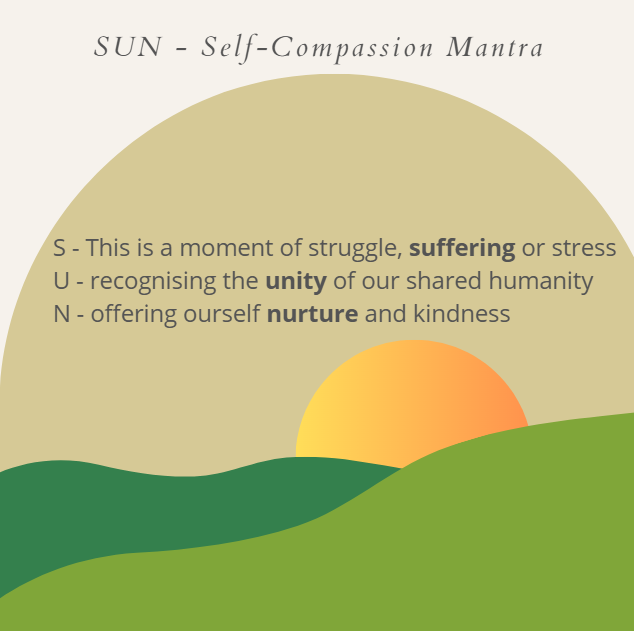
The teachings of the MBCL course have been fundamental to this process. During the MBCL course, we learn about self-compassion: its value, why it can be so challenging to apply for many of us, and how we can find gentle ways to be more compassionate with ourselves and others, for example, befriending our inner critic. Two of my favourite practices which support with growing compassion are the compassionate companion practice and the embodying compassion meditation. Likewise, the self-compassion mantra is a tool I find myself turning to at some point most days. This simple practice can radically shift my energy in a difficult moment. You can find a guided audio practice here.
We also take time to explore resistance and acceptance, and the crucial difference between acceptance and resignation. The practice of exploring and relating to resistance helped me appreciate how much energy I was using to resist certain moods, and how they softened and opened of their own accord if I gave them the space and care they needed.
Recognising unhelpful patterns and responding kindly and wisely is another practice from the course which has had a big impact on me. Depending on how resourced I feel at a given time I can work on small patterns (like the impact of negative internal dialogue relating to certain household chores) to depth work such as my tendency to catastrophise (familiar to many who have experienced depression) that I'm on the verge of full-blown depression when the first flavours of low mood present themselves. Learning to work with patterns in this kind and gentle way has opened up a sense of agency.
Another powerful aspect of the course that has had a big influence on my life has been the introduction of the four friends for life (the Brahmaviharas in Buddhist teaching). Through teachings and practices that explore kindness, compassion, joy, and equanimity, we learn to tune in to what may be needed in the moments of our lives as we relate to ourselves and others. These teachings are helping me to find more balance: for example, developing an ability to savour the pleasant in life as well as be with the challenging.

Deepening my formal loving kindness practice is also something I have found very nourishing. Over time, the practice has shifted from formal meditation and into daily life. I regularly notice myself silently sending kind wishes to others, sometimes joyfully, for instance, on noticing children playing in the park, and sometimes in response to a challenge, such as impatiently standing in a busy queue.
The course is rich and offered so much that I chose to attend twice as a participant, first with The Mindfulness Network, each time deepening my understanding and practice, before deciding to train to teach this life-changing course, training directly with Erik and Frits themselves. That teacher training was also an enriching experience with a lovely sense of community and new layers of learning.
I love teaching the 8-week MBCL course and sharing insights and practices with clients during coaching sessions. I was also privileged to have the opportunity to interview Erik and Frits, the course co-creators, for season two of my Realise Mindfulness podcast, which explores some core elements of the course. I strongly believe that the teachings on kindness and compassion that the course offers are precisely what the world needs right now, and I am grateful for the opportunity to be both a learner and a teacher.
If that sounds of interest to you, I would encourage you to experience Mindfulness-Based Compassionate Living for yourself. You can find out more about forthcoming courses here, or get a taster with season two of the Realise Mindfulness podcast.
This piece was originally written as a volunteer contribution for The Mindfulness Network's blog. You can find out more about The Mindfulness Network here.


Comments