


Duir: The Ancient Wisdom of the Oak

Roots, branches, and the wisdom of what stands still while everything grows.
In the Celtic Tree Calendar, the Oak month (Duir) spans June to July. Growing up in Yorkshire, I always thought of the Oak as a particularly northern, particularly British tree. So it was a lovely surprise, researching this piece, to discover just how far its roots really travel, and how, the deeper I dug, the earliest layer of the story turned out to be rooted in the feminine.

Honouring the Divine Feminine
The earliest oak spirits in Greek myth were the dryads, female spirits believed to live within the tree itself, not separate from it but woven into its bark and branches. Long before Zeus laid claim to the great oracle at Dodona, the site belonged to an older, earthier power: a goddess named Dione, an early form of the Earth herself. Pilgrims came to hear her voice in the rustling of the oak leaves and the murmuring of doves nesting in its boughs. Zeus arrived later, and over time was credited as the one speaking. You can still see both their temples standing side by side in the ruins today, hers quietly overshadowed by his. Perhaps a fitting symbol for how the patriarchy has often sought to silence or overshadow feminine wisdom it doesn't fully understand.
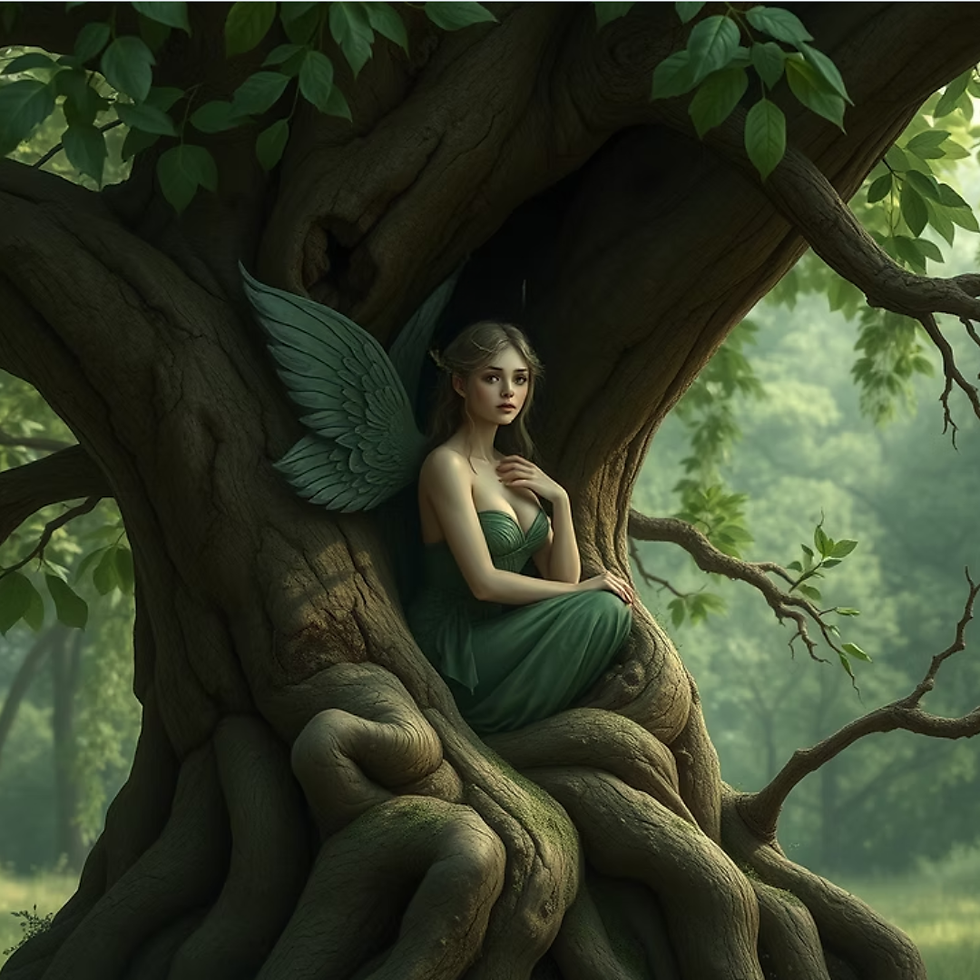
It's a pattern that repeats itself across the ancient world. Delphi, too, began as a shrine to the earth goddess Gaia before Apollo made it his own. When Jason built the Argo, it was Athena who fitted its prow with a timber cut from the sacred Dodona oak, giving the ship a voice of its own to warn the crew of danger. Wisdom, it seems, so often began in female hands whilst the glory was granted to the heroes of the story.
Closer to Home
The Oak's British story is also rooted in both the spiritual and the mystical. Across England, "gospel oaks" once marked parish boundaries, where villagers gathered each year to walk the bounds and hear scripture read beneath the branches. These traditions were built upon earlier pre-Christian traditions which recognised oak groves as revered meeting places.
In Ireland, the other half of my ancestry, preaching trees were also well known for offering shelter to the "Hedge Priests", outlawed priests who ministered to rural Catholics, keeping the Irish language and classical education alive by conducting classes in barns, under the shelter of trees and behind hedgerows to avoid detection by authorities.
I like to think of my own English and Irish roots intertwining in this way, and also honouring the sacred feminine. I am proud to say my mum was one of the very first women vicars in the UK, and held one of the most inclusive, enlightened ministries I have known. Her warmth, her acceptance, and her spiritual direction continue to offer fertile ground for my own eclectic spiritual wanderings, even though she is no longer here.
I'm equally proud of my dad, who has led a life of service, first as a teacher and a county councillor, and later as a lay reader supporting my mum's ministry. In his own way he was ahead of his time, an early feminist, an ardent socialist, and a supporter of the rights of others. On recent visits home, there have been tender opportunities to explore old family memories together, a way of gathering in our own family myths even as his memory begins to fade.
Sitting with the Oak
In Welsh tradition, the very word Druid is thought to mean "knower of the oak". Merlin himself is tied to the oak groves of Carmarthen, where local lore still points to a site called Merlin's Oak.
To the ancient Celts and Druids, the Oak (Duir) was the most sacred tree of all: a symbol of endurance, sovereignty, and the triumph of light. Its Gaelic name literally means "door" or "gateway", and I find that a beautiful image to sit with as I mark another year.
What strikes me most, sitting with all of this, is how much these old stories still influence us. They are part of a shared unconscious. Myth isn't just history, it's the language of our psyche, it flavours the stories we tell, whether in our dreams, the language we use, or reflected on the pages of a book or the silver screen. Myths help us make sense of life's complexities and contradictions: love, loss, the desire for certainty, and the constant of change.

That's precisely the territory I've been drawn deeper into this year, undertaking training in transpersonal psychology. One module I particularly enjoyed was working with Jungian archetypes, exploring the Tarot as a mirror for what the rational mind can't always name. Jung described synchronicity as a meaningful coincidence, those moments when something in the outer world seems to mirror something stirring within us. Tarot can offer a way of noticing and exploring those moments with curiosity rather than certainty. The Oak feels like a fitting companion for transpersonal work: a tree whose roots reach as far into the earth as its branches reach toward the sky. As above, so below.
If you'd like to take your own practice with the Oak deeper, you might enjoy tuning into my tree meditation, one of my favourite nature-inspired meditations, and a lovely way to sit with these themes in the body, rather than only in the mind (simply scroll to the bottom of my audio resources page).
For further ways to deepen your relationship with oak, you don't need to live near an ancient oak to begin. Here are some ways to bring the spirit of Duir into your own practice:
Find an oak tree near you and choose it as a sit spot, a place you return to and observe through the changing seasons. Notice its qualities of strength, rootedness, and presence, and how these shift and stay constant as the year turns.
Meditate on its qualities. Endurance. Stability through seasonal change. The quiet wonder of how a mighty tree grows from something as small as an acorn.
Create a small nature altar, with leaves and acorns, or take time to learn more about some of the traditions and legends explored above, and find your own way to integrate them into your spiritual practice.
Use oak symbolism, its roots, its rings, its yearly cycle, as a starting point for journaling or art, a way of exploring your own growth and what lies beneath it.
Grow Opportunities and Seasonal Rhythms
Some of what follows is tied to specific dates in 2026, and some of it is simply part of the seasonal rhythm of what I offer year on year. If you're reading this outside of these particular months, these threads tend to come round again, so do reach out and I can let you know what's next.
This summer, I launched my Nature Tarot coaching sessions, a quiet way to sit with the Tarot's archetypal language as a mirror for whatever threshold you're standing at, offering a reflective space for exploring the questions that don't always yield to logical thinking. Using the archetypal language of the Tarot, the wisdom of the natural world, and a transpersonal coaching approach, we gently explore what may be unfolding beneath the surface. The cards become mirrors rather than predictions, inviting intuition, reflection, and fresh perspective.

Growing Community
One of the highlights of 2026 for me has been teaching the very first run of MBSR: Grounded Presence, and using the evaluation from that course to support my Masters thesis on weaving Earth-awareness into the established MBSR curriculum. It's been a joy to watch what happens when nature connection is woven honestly into that structure, rather than added as an afterthought. I'll be sharing more of what I learned, and what surprised me, in a talk at the Manchester Mindfulness Festival in October 2026, alongside a contribution from Margaret Fletcher and Trish Magyari, co-directors of the MBSR and EcoAwareness Project. It's an annual festival held each autumn, so if you're reading this after October 2026, it's well worth keeping an eye out for future years too.
Take Root, Then Branch Out
Just as the Oak sends roots deep to hold branches that reach ever wider, MBSR: Grounded Presence invites you to root your practice in stillness, and let it branch outward into the living world. This 8-week journey weaves traditional mindfulness with nature-inspired awareness, helping us rediscover that we are not separate from the Earth, but part of its living body. Grounded Presence runs periodically throughout the year, with tiered pricing to keep it accessible. If it speaks to you, get in touch to find out when the next cohort begins.
Mindfulness-Based Compassionate Living. I also bring my own nature-infused, embodied approach to this wonderful deepening course, which I run periodically for those ready to deepen an existing mindfulness practice. Get in touch if you'd like to find out when the next course is starting.
These offerings ebb and flow with the seasons, much like the Oak itself. Whenever you're reading this, you're welcome to reach out and ask what's currently open.


Comments