


The Heroine's Journey: What Happens When We Stop Trying to Be the Hero?

We went to see The Odyssey at the cinema recently. I went with my husband and our two young adult boys (I hesitate here what to call them – boys? Men? Males? I guess in some primal way they will always be boys in my heart, in the same way my mum told me, during a time of distress in my late thirties, that I would always be her baby, i.e. she would always be concerned for my wellbeing and comfort me).
It's fair to say we all enjoyed the film in our own ways. But personally, I couldn't help thinking that I am bored of the hero's journey, the swashbuckling, the testosterone, the posturing and ego and, well, I guess the need to be seen as heroic.

I was much more interested in the female characters. Penelope, the loyal and canny wife. Circe, the witch. Helen, so much more than just a pretty face. And I started wondering whether these ancient stories might offer us another way of understanding the journey: not as a quest for conquest and achievement, but as a journey towards wholeness.
This is the kind of inner quest that Jungian Psychotherapist Maureen Murdoch terms the Heroine's Journey, a model with its own ten stages, moving away from the feminine, into the masculine world of ego and achievement, through a kind of spiritual death, down into descent, and eventually back towards integration.

Take Penelope. She's usually painted as the patient wife, waiting faithfully for twenty years while her husband is off having adventures. But patient isn't the same as passive. She's got a household full of suitors eating their way through her resources and pressing her to remarry, and instead of fighting them head on, she outwits them, most famously by promising to choose once she's finished weaving a burial shroud, then quietly unpicking it every night so it's never done. That's not nothing. That's knowing how to wait, how to watch, how to hold your cards close and act without giving the game away. It's a kind of power that doesn't announce itself, and I think it's one that’s often underestimated.
Then there's Circe, who I find genuinely fascinating. A witch, living outside ordinary society, with knowledge and abilities that Odysseus simply can't overpower. She turns his men into pigs. He arrives braced for another monster to fight, and instead, once he survives the encounter, she becomes his lover, his host, and then his guide, telling him how to carry on, sending him towards the Underworld, giving him the knowledge he needs for what's coming. The dangerous woman turns out to be the wise one. The witch becomes the guide.
This part of the story maps rather beautifully, I think, onto one of the pivotal stages in Murdock's model, what she calls the descent to the Goddess. Circe isn't an obstacle on the road of trials. She's the one who initiates the descent itself, the figure standing at the entrance to the underworld, sending the protagonist down into the depths that can't be reached without guidance.

And Helen. For centuries she's been flattened into "the face that launched a thousand ships", as if beauty were the only interesting thing about her. But in The Odyssey she's sharp. She sees through Odysseus's disguise. She reads people and situations well. And she knows plants and medicines: when Telemachus arrives in Sparta grieving for his father, she slips something into the wine that Homer says eases sorrow.
There's something in that moment that sits close to another part of Murdock's map, the point after the old achievement-driven self has hit its spiritual aridity, its own quiet death, when what's needed isn't more striving but a different kind of medicine. Helen holds that. The capacity to actually tend grief, rather than push past it or perform through it.
And these are, I think, exactly the capacities that mindfulness and compassion practice cultivate too. The ability to sit with what's hard without rushing to fix or flee it. This feels particularly alive right now, as we hold the grief of the climate crisis and try to find our way, not into empowerment exactly, but into something more like agency: a felt sense that we can still act, still respond, still show up, even inside grief rather than in spite of it.

Which makes me look differently at the monsters too. Scylla and Charybdis, in Greek myth, are actually feminine forces in their own right, with their own mythology, rather than simply obstacles invented for a hero to overcome. They are the sea itself: wild, uncontrollable, dangerous. Odysseus can't defeat them, only navigate between them.
And maybe that's the point. What happens when the masculine runs into something it can't control, something wild, embodied, cyclical, mysterious, something that won't be subdued by force? Maybe we call it a monster. Maybe we send the hero off on a quest so he can meet it, negotiate with it, and somehow survive what we haven't yet worked out how to integrate. I don't think that means these myths were simply dreamed up by men afraid of women, that feels too naive an answer.
But I do wonder if some of them are carrying a kind of cultural memory of how hard it's always been to meet forms of feminine power that don't fit tidily into wife, mother or maiden. The witch. The wild woman. The wise woman. The woman who knows something the hero doesn't.
This is where the Heroine's Journey speaks to me. Murdock's model traces a movement away from the feminine and towards achievement, and then a crisis, when all that striving stops giving you what you actually need. And the journey turns downward, into grief, uncertainty, a kind of spiritual aridity, and into the parts of ourselves we left behind to get where we were going. It's a descent. And I think descent makes us deeply uncomfortable, because we're so trained to look for the ascent instead: progress, growth, achievement, more.
But what if real transformation and integration might only happen when we are prepared to face the descent. In many ways this is how life begins, as we descend the birth canal during labour. Stanislav Grof, who spent his career exploring the relationship between consciousness, psychological crisis and spiritual transformation, wrote a lot about how experiences that feel disorientating or difficult at first can become deeply meaningful once we're able to meet them as part of something, rather than something to escape.

That's not about romanticising suffering, or pretending every hard thing is secretly a gift. It's about staying curious about what opens up when we don't immediately turn away from what's difficult. Sometimes the way through really is down.
Maybe that's why I'm increasingly drawn to the Heroine's Journey. It doesn't ask us to get better at the game we're already playing. It asks us to question the game itself. To notice what we've sacrificed along the way to succeed. To meet the parts of ourselves we've written off as too much, too irrational, too wild, too emotional. To go down into the places where our usual strategies stop working, and, like Odysseus with Circe, to find that what looked like the obstacle might actually be carrying the knowledge we need.
This isn't about rejecting the masculine. It's about healing the split. Action and receptivity. Strength and softness. Doing and Being. Discernment and intuition. Independence and belonging. The part of us that knows how to navigate the world, and play by the rules and the part that knows how to listen to the truth beneath the noise and march to our own tune.
And I keep coming back to Penelope, because she resists being pinned to a single stage in a way the other two don't. You could read her at the very start of the map, the loyal wife, the ideal of a womanhood defined entirely in relation to a husband who isn't there. Or you could read her at the end, as something closer to integration itself, someone who never left the feminine to chase achievement in the first place, and so was never split, holding action and receptivity, discernment and patience, all at once, for twenty years, without needing to announce any of it.
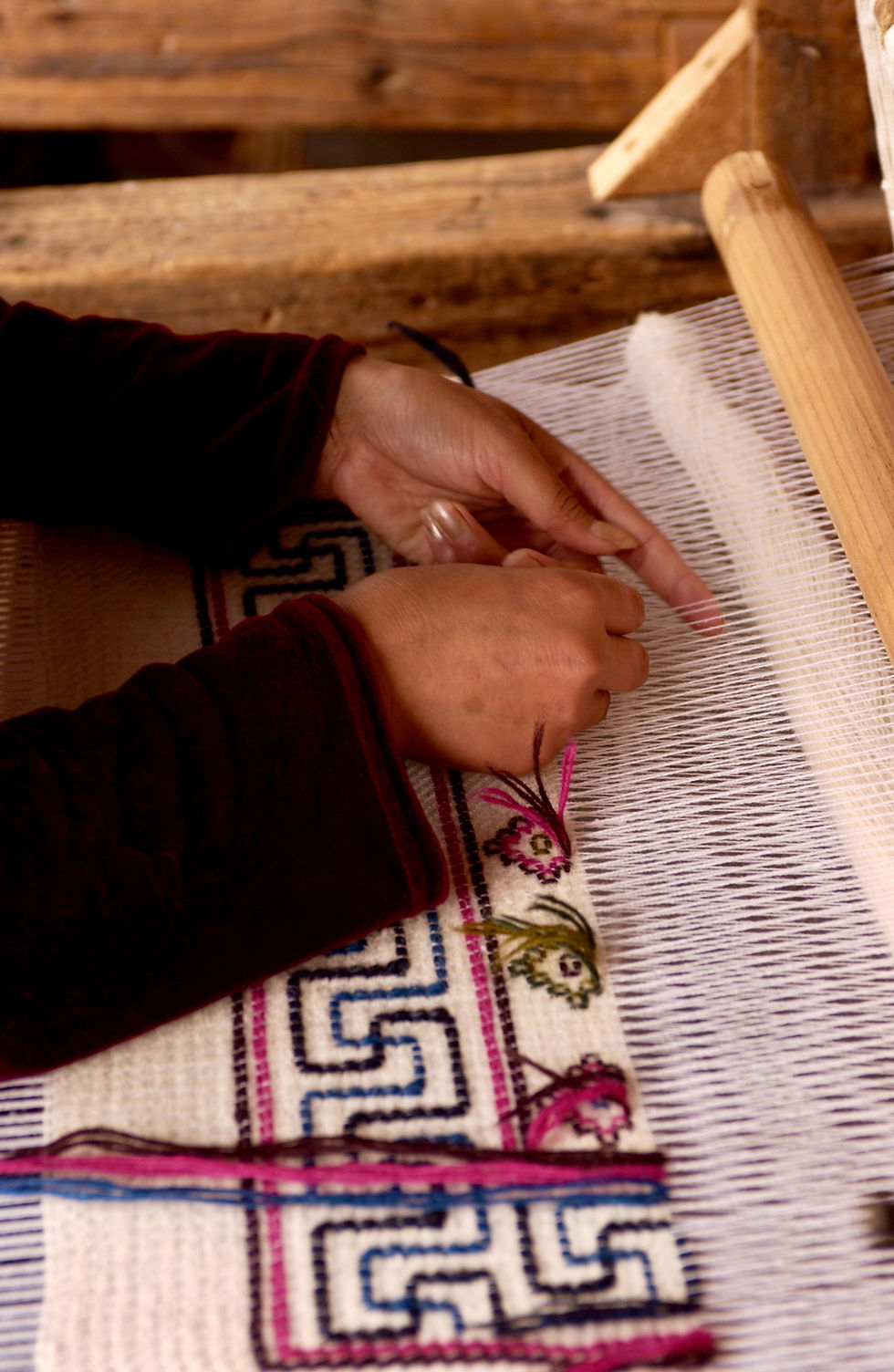
Maybe both are true. Maybe that's rather the point. None of us fit neatly into a ten-stage model, arriving tidily at each waypoint in order. Real journeys loop back on themselves, hold two things at once, refuse to resolve. Penelope might be less a stage on the map than a reminder that the map is only ever a rough guide to something far less linear.
So I'm less interested these days in the hero who slays the monster. I'm interested in what the monster knows. In the woman who waits and weaves her own story. The witch who turns out to be the guide. The woman who knows how to ease grief. The wild thing that was never meant to be conquered. And in what becomes possible when we stop trying so hard to be heroic, long enough to actually listen to the deeper story underneath.
This is, I think, why our own inner depth and transpersonal work matters so much. Not shying away from the journey to the depths, but recognising Maybe the real journey was never about becoming heroic at all. Maybe it's about becoming whole.



Comments